
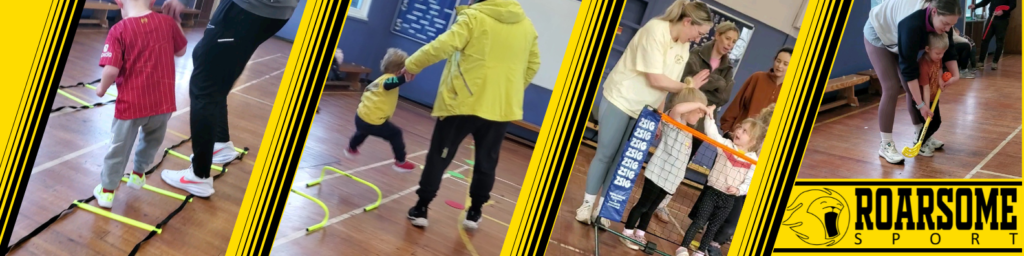
When we think about children starting sport, it’s easy to focus on the physical skills — running, throwing, catching or kicking. But in reality, the foundations of a positive experience in sport are built much earlier than that.
They begin with how a child feels.
Feeling comfortable in a new environment, feeling connected to the people around them, and feeling confident enough to have a go all come before any skill development. For many young children, that sense of security comes from having a familiar adult close by.
I often speak to parents who are worried that their child might not join in when they come to a session. They might be shy, unsure or overwhelmed by something new. What I always explain is that joining in doesn’t have to mean immediate independence. For some children, it might look like sitting on a parent’s lap and watching, holding a hand while taking part, or dipping in and out of activities. All of that is part of the process.
In fact, it’s an important part of the process.
A parent said to me recently that “Roarsome Sport is permission to play,” and I think that captures it perfectly. When parents get involved, when they run, play and share those moments with their child, it changes the dynamic completely. The pressure disappears and is replaced with connection.
From that place, confidence grows naturally.
I’ve seen this recently with two young children who joined sessions around six months ago. They started in a very similar way, staying close to their parents and watching carefully before joining in. Over time, as they became more familiar with the environment and the structure of the sessions, they began to take part more. In the past few weeks, that confidence has really developed. They’re now joining in fully, following the games and playing alongside others.
Their parents are still part of the experience, but now as playmates rather than a place to hide.
This idea is just as important in SEND settings. In a specialist school I work in, one of the advantages is having enough staff to be able to understand each child and who they feel most comfortable working with. Sometimes a child will respond really well to one adult but struggle with another, and it’s not about anyone doing anything wrong. It can be something as subtle as a smell, a tone of voice or even a visual detail like clothing.
Being able to recognise that and adjust accordingly allows the child to feel more regulated and secure, which in turn makes engagement much easier.
The same principle applies more widely. Children don’t develop confidence by being pushed beyond what they can manage. They develop it by starting in a place where they feel safe and supported, and gradually building from there.
Those early experiences matter more than we might think, because they shape how children feel about movement, sport and their own abilities for years to come.