
If you’ve ever taken your child to a sports session and found it ended in stress, overwhelm, or refusal to join in, you’re not alone.
Many traditional sports sessions are built around things that can be genuinely difficult for neurodivergent children, such as listening to lots of verbal instructions, following complex rules, coping with noise and unpredictability, waiting turns, and managing the pressure of “getting it right”.
For some children, those expectations are simply too much, too soon.
That’s why play-based sport can be such a game-changer.
Play allows children to move in a way that works for their brain and body
Play isn’t just a fun extra. It’s one of the most effective ways children learn.
Through play, children naturally build coordination, balance, strength, agility and confidence. But for SEND children in particular, play is often the bridge into movement because it supports something even more important first: regulation.
Play gives children freedom to explore, repeat movements that feel calming, take breaks when needed, and engage at their own pace. It takes away the pressure of doing things “properly” and helps movement feel safe.
Why rules-heavy sport can feel overwhelming
Many children don’t struggle with the sport itself — they struggle with the demands around it.
Rules-heavy games often require quick processing, strong impulse control, and lots of social awareness. If a child becomes overwhelmed, you might see behaviours like running away, refusing, freezing, shouting or becoming upset.
These reactions aren’t a child being “difficult”.
They’re communication.
They’re the child showing you that their nervous system is overloaded.
Communication must be flexible too
One of the biggest lessons I’ve learned working with SEND children is that communication needs to be just as adaptable as the sport itself.
Many of the preverbal children I work with don’t respond to spoken instructions in the way adults expect, especially if they’re already overwhelmed. Repeating instructions louder rarely helps.
Instead, I’ve created simple visual tools that allow children to understand the games, make choices, and feel safe enough to join in.
Sometimes this means the activity doesn’t look like the textbook version.
But if children are engaged, moving and having fun, then it’s working.
The goal isn’t perfect participation — the goal is building confidence and a positive relationship with movement.
Practical examples of playful movement that supports sensory needs
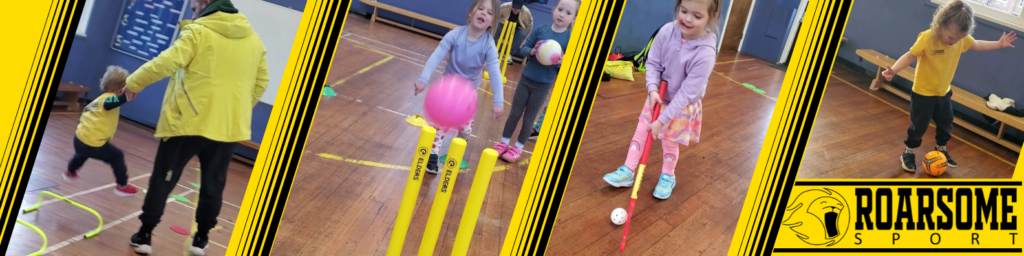
Playful movement can be incredibly simple. Here are a few activities that work brilliantly for many SEND children:
Heavy work play (great for regulation)
- pushing a ball or weighted object
- carrying beanbags to a target
- pulling a resistance band
- crawling through obstacle courses
Repetitive, rhythmic movement
- running between cones
- jumping between floor markers
- bouncing or hopping challenges
- rolling a ball back and forth
Sensory-friendly aiming and throwing
- throwing soft balls into buckets
- rolling balls into goals
- knocking down skittles
- beanbag target games
Choice-based play
- letting children choose between two stations
- giving picture cards for activity options
- “pick your challenge” movement cards
Final thought
Play isn’t “less than” sport.
For many neurodivergent and SEND children, play is the most inclusive version of sport there is. It allows them to move in a way that works for them, build confidence, and feel successful.
And when children feel safe, they’re far more likely to keep coming back.